The short version
- 1VRV is Daikin's name (Variable Refrigerant Volume). VRF (Variable Refrigerant Flow) is the generic term. The technology is the same.
- 2Both run many indoor units from one inverter outdoor unit and give each room its own temperature control.
- 3The question that matters is multi-zone VRF versus several ductable, cassette or split systems, not VRV versus VRF.
- 4Price and brand depend on your building. We quote from drawings or a site survey, not from a list.
If you have searched for 'VRV vs VRF difference', you have probably seen quotes that use both words and wondered if they are two different systems. They are not.
The short answer
VRV stands for Variable Refrigerant Volume and is a trademark of Daikin, which introduced the technology in 1982. VRF stands for Variable Refrigerant Flow and is the generic industry term. Other manufacturers sell the same idea under their own product names.
| Brand | Their name for it |
|---|---|
| Daikin | VRV |
| Mitsubishi Electric | City Multi |
How a VRV or VRF system works
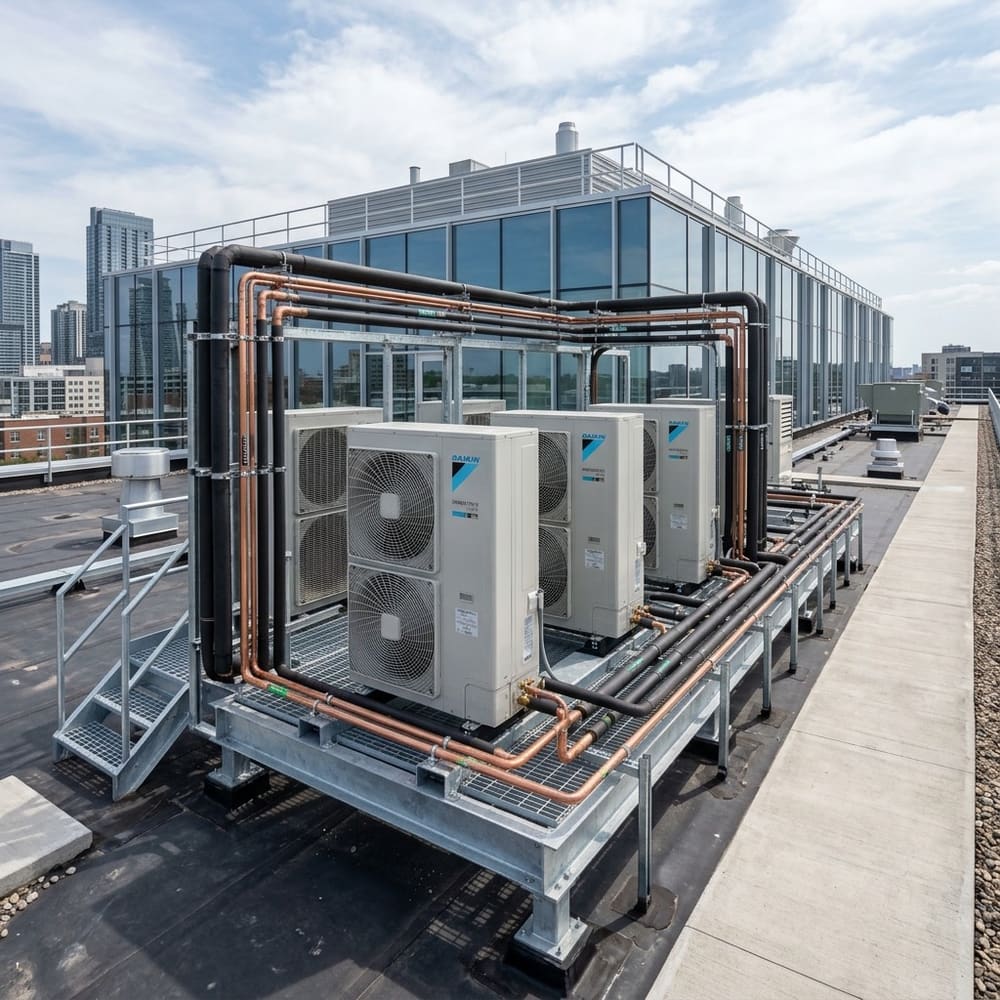
One inverter-driven outdoor unit connects to many indoor units through shared copper refrigerant piping. Each indoor unit has its own electronic valve and controller. When only a few rooms need cooling, the outdoor compressor slows down instead of switching on and off. That part-load behaviour is where the energy saving comes from.
- Zone control: every cabin, shop section or apartment sets its own temperature and schedule.
- One outdoor deck: one outdoor unit or module group on the roof replaces many outdoor condensers on the facade.
- Mixed indoor units: wall-mounted, cassette and ductable units can share one system.
- Building controls: BACnet or Modbus gateways connect the system to a building management system.
VRF versus separate ductable, cassette or split systems
This is the choice that changes your cost and comfort. The right answer depends on how many zones you have and how differently they are used.
| Multi-zone VRF/VRV | Separate ductable, cassette or splits | |
|---|---|---|
| Best for | Many rooms with different usage: offices, hotels, retail chains, villas | One large open floor, or a few rooms with similar use |
| Part-load efficiency | Strong: outdoor compressor follows total load | Each unit cycles on its own |
| Outdoor units | One module group | One per unit or per few units |
| Piping | Long shared refrigerant lines to design and test carefully | Short, simple runs |
| Upfront cost | Usually higher for small projects; evens out as zones increase | Often lower for one or two zones |
| Single point of failure | Outdoor unit serves many rooms | A fault affects one zone |
What decides the price
There is no honest flat price for a VRF system. These factors move the quote:
- Total cooling load in TR, set by area, glazing, occupancy and equipment.
- Number and type of indoor units (wall, cassette, ductable).
- Refrigerant pipe length, number of floors and height difference.
- Brand and series, controllers and any BMS integration.
- Roof or terrace preparation and electrical supply upgrades.
- Whether the AMC is included from day one.
What a good VRF installation includes
- 1Heat-load study
Room-by-room load, not a single guess for the whole floor.
- 2Design and piping layout
Outdoor and indoor selection, branch joints and a piping drawing.
- 3Brazing and testing
Joints brazed under nitrogen, then a long pressure hold and deep vacuum.
- 4Commissioning
Charge by weight, addressing, test run and a signed report.
- 5Maintenance plan
Scheduled checks keep the system efficient and catch leaks early.
Our VRF & VRV systems service page covers the process in detail, and our Daikin VRV dealer page lists the Daikin series we install. For upkeep, see the VRF maintenance guide.
Frequently asked
Is VRV better than VRF?
Not inherently. VRV is Daikin's version of VRF. Which brand suits you depends on the building, the service support in your city and the budget.
Is a VRF system the same as a split AC?
It uses the same refrigeration principle, but one outdoor unit serves many indoor units and varies capacity continuously. A split AC pairs one outdoor unit with one or a few indoor units.
Can VRF be added to later?
Often yes. Outdoor systems are modular and piping can be sized with spare capacity, but plan it at design stage.
How do I get a VRF quote?
Send drawings or book a site survey. We prepare the heat-load, selection and a written quotation.

Proprietor, Sri Engineering Works. Sri Engineering Works has installed and maintained HVAC systems across Telangana and Andhra Pradesh since 2018, from home splits to VRF plants and chillers.