

The short version
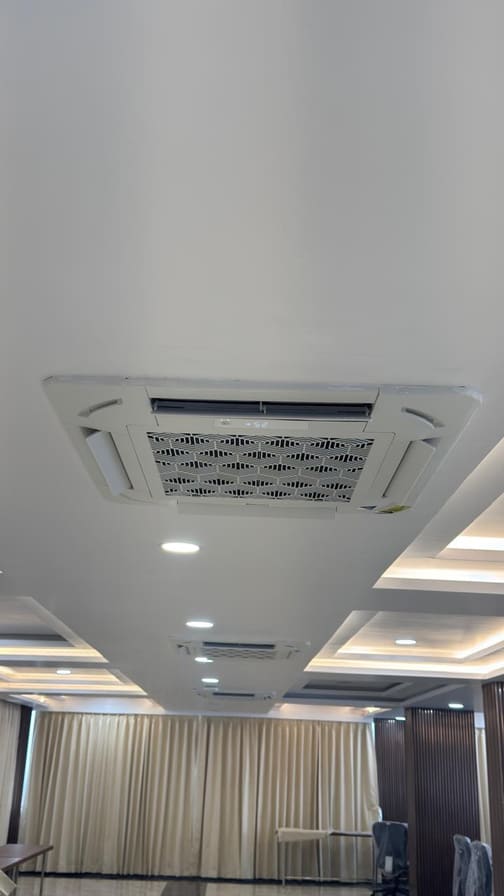
- 1A cassette is a slim unit set into the ceiling that blows air in several directions. No ducting.
- 2A ductable unit sits above the ceiling and sends air through ducts to grilles or diffusers. Best for large open floors.
- 3Cassettes suit medium rooms with a false ceiling. Ductables suit big, open areas and spaces that need several outlets from one unit.
- 4Both can also be indoor units on a VRF system.
Clients usually ask us to choose between ductable and cassette once they have decided against wall-mounted splits. Both keep the equipment out of sight. But they behave very differently once installed.
What each one is
Cassette AC
- Fits into the ceiling grid with only a panel visible
- Throws air in several directions
- Built-in drain pump on most units
- No ductwork to fabricate
- Best for rooms up to a moderate size
Ductable AC
- Whole unit hidden above the false ceiling
- Air distributed through ducts to grilles or diffusers
- One unit can feed several outlets
- Needs duct design, fabrication and balancing
- Best for large open floors and halls
Side-by-side comparison
| Cassette AC | Ductable AC | |
|---|---|---|
| Airflow | Spreads from the unit in several directions | Delivered where you place grilles and diffusers |
| Visible parts | Decorative panel in the ceiling | Grilles or diffusers only |
| Installation | Cut ceiling opening, pipe, drain, wire | Duct design, fabrication, insulation, balancing, plus piping |
| Space above ceiling | Needs enough void for the unit; confirm per model | Needs room for unit and ducts |
| Noise in the room | Unit is in the room's ceiling | Unit sits above the ceiling, so quieter at the occupant when ducted well |
| Capacity per unit (our range) | About 1 TR to 4.7 TR | About 1 TR to 16.5 TR |
| Best for | Cabins, clinics, boutiques, restaurants, boardrooms | Showrooms, banquet halls, supermarkets, open offices |
How to choose
- Room shape: square or near-square rooms suit a central cassette. Long, wide or irregular floors suit ducting.
- Ceiling void: measure the space above the false ceiling before choosing. Cassettes and ducts both need room.
- Number of zones: if one large area needs even cooling from several outlets, ductable is the better fit.
- Look: if you want no visible unit at all, ductable with slot diffusers is the cleanest finish.
- Budget and timeline: cassettes install faster because there is no duct fabrication.
- Future changes: ductable layouts are harder to alter once the ceiling is closed.
A mixed layout is common
In an office we often use cassettes in cabins and meeting rooms and a ductable for the open workstation area. If the building has many such zones, it may be worth pricing a VRF system, where cassette and ductable units are indoor units on one network.
See our cassette AC and ductable AC & AHU pages for specifications and project photos, and our cassette price guide for what drives the cost.
Frequently asked
Which is cheaper, cassette or ductable?
It depends on the space. For a single medium room a cassette is usually simpler and quicker. For a large open floor, one ductable with proper ducting can be more economical than several cassettes. We quote both when it is close.
Which is quieter?
A well-designed ductable system is quieter in the room because the unit is above the ceiling, but duct design and diffuser selection matter. Cassettes are quiet too, and their sound level is listed per model.
Can I use a cassette in a house?
Yes, if the ceiling has a false ceiling void. Wall-mounted splits are still the usual choice in most homes.
Do I need ducting for a cassette?
No. A cassette throws air directly from the ceiling unit. A fresh-air duct is optional.

Proprietor, Sri Engineering Works. Sri Engineering Works has installed and maintained HVAC systems across Telangana and Andhra Pradesh since 2018, from home splits to VRF plants and chillers.