

The short version
- 1Use Dry mode on humid, mild days. It removes moisture with less power than full cooling.
- 2Protect against surges: switch the AC off at the MCB during thunderstorms.
- 3Outdoor units are built for rain, but not for standing water or blocked drainage around them.
- 4Clean filters more often in the monsoon, and run the fan after cooling to keep mould away.
People assume the monsoon is the AC's holiday. In Hyderabad and coastal Andhra, it's the opposite. Temperatures drop a little, but humidity shoots up, and a sticky 30°C day with 85% humidity can feel worse than a dry 38°C one.
Your AC works differently in this weather. It spends more of its effort pulling water out of the air than cooling it. Here's how to look after it.
- Dry mode
- Best setting for humid days that aren't very hot
- 3–4 wks
- Filter cleaning interval during monsoon
- MCB off
- During thunderstorms and lightning
1. Use Dry mode on humid days
The water-drop icon on your remote runs the AC gently to pull moisture out, without chilling the room. On muggy days that aren't very hot, it's more comfortable and uses less power than full cooling.
2. Switch off at the MCB during storms
Lightning and grid switching during storms cause voltage spikes that can damage an AC's control board, which is one of the more expensive parts to replace. The remote only puts the AC on standby. For real protection, switch off at the MCB until the storm passes.
3. Don't cover the outdoor unit while it runs
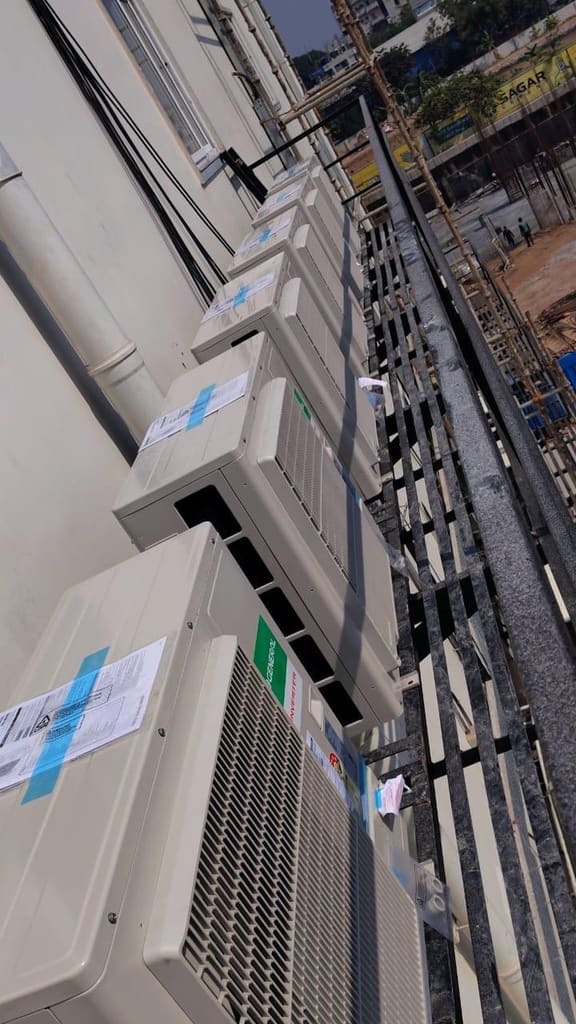
Outdoor units are designed to sit in the rain. What they can't handle is being wrapped in plastic while running, which traps heat, or covered in a way that holds water against the metal. A small sloped shade above the unit is fine. A tight cover is not.
4. Check for standing water around the outdoor unit
Units on ground-level pads or terraces with poor drainage can end up sitting in water. That rusts the base and can reach the electricals. Make sure the stand keeps the unit well above any pooling, and clear the terrace drains.
5. Clean filters more often
Humid air plus dust makes a sticky film on filters much faster than in dry weather. Every three to four weeks is a good monsoon rhythm.
6. Keep the drain line clear
Your AC produces the most condensate water of the year in the monsoon. A partly blocked drain that coped in March will overflow in July. If you see drips or wall stains, read our water leak guide.
7. Dry the coil after use
Run the fan for 10 minutes before switching off, or use your model's auto-clean function. A dry coil is a coil where mould struggles to grow, and it prevents that damp smell when you switch back on.
8. Check the insulation and wall hole
Rain finds gaps. Check that the hole where the pipes pass through the wall is properly sealed, and that the pipe insulation outside isn't cracked or peeling. Water seeping in along the pipes is a common cause of damp patches on inside walls.
Post-monsoon checklist (October)
- Outdoor unit fins cleared of leaves, mud and insects
- Stand and bolts checked for rust
- Drain line flushed
- Filters and coil cleaned
- Any musty smell dealt with before winter storage

Proprietor, Sri Engineering Works. Sri Engineering Works has installed and maintained HVAC systems across Telangana and Andhra Pradesh since 2018, from home splits to VRF plants and chillers.