

The short version
- 1A clogged filter or a blocked outdoor unit causes more 'not cooling' calls than anything else, and you can fix both yourself.
- 2If the outdoor fan is not spinning, switch the AC off. Running it that way can damage the compressor.
- 3Ice on the copper pipes almost always points to low airflow or low refrigerant. It is not a sign the AC is 'working extra hard'.
- 4Gas top-ups without finding the leak are a waste of money. Refrigerant does not get 'used up'.
It's 3 PM in May, the AC has been on for an hour, and the room still feels like the inside of an auto-rickshaw. We get this call more than any other through the summer, and the good news is that a fair share of these visits end with us cleaning a filter and leaving.
Here are the causes we see most often, roughly in order of how common they are. The first few you can check yourself in ten minutes. After that, it's technician territory.
1. The filter is choked with dust
Pop open the front panel of your indoor unit. If the mesh filters look grey and felt-like, you've probably found your problem. A dirty filter chokes the airflow over the cooling coil, so the cold never actually reaches the room. In dusty parts of Hyderabad, filters can clog up in two to three weeks of heavy use.
2. The mode or temperature is set wrong
Sounds obvious, but it happens a lot, especially after kids get hold of the remote. Check that the mode shows the snowflake icon (Cool), not Fan, Dry or Auto. And setting 16°C won't cool the room any faster. The compressor runs at the same speed either way. It just keeps running long after the room is comfortable.
3. The outdoor unit can't breathe
The outdoor unit's whole job is to throw heat out of your home. If it's boxed in by a grill with no gap, covered with a plastic sheet, sitting in direct 45°C afternoon sun on a terrace, or blowing hot air straight into a wall, the heat has nowhere to go. It ends up recirculating back into the condenser.
- Keep at least 30 cm of open space behind and 50 cm in front of the outdoor unit.
- Clear leaves, plastic bags and bird nests from the fins.
- A simple shade (not an enclosure) over a sun-baked unit helps noticeably in peak summer.
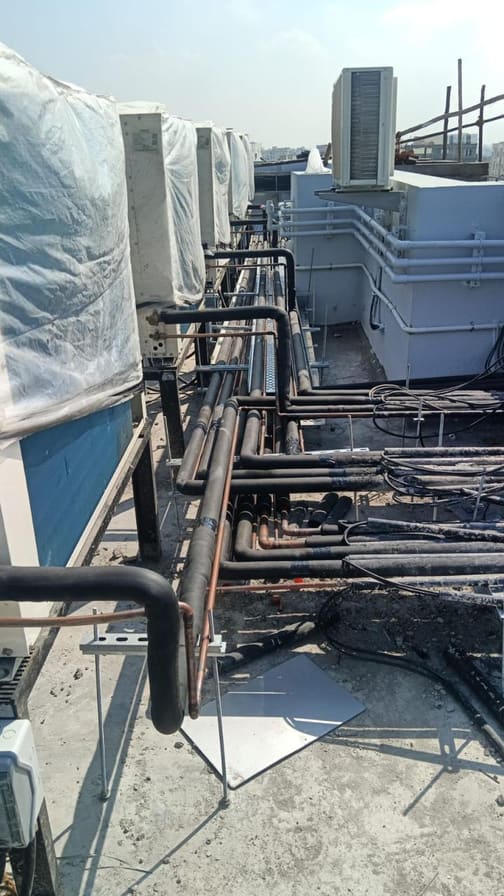
4. The outdoor fan or compressor isn't starting
Go outside and look. If the indoor unit is blowing but the outdoor fan is still, or it hums without spinning, the usual suspect is a failed capacitor: a small, inexpensive part that gives the motor its starting kick. Capacitors weaken with heat and voltage fluctuation, and they fail most often in the first heatwave of the year.
5. Dirty coils, even with clean filters
Filters catch the big dust, but fine particles, kitchen grease and moisture still build a film on the cooling coil over a season. On the outdoor side, the condenser fins collect pollen, dust and cottonwood fluff. Either one cuts heat transfer. This is what a proper wet service with a pressure jet fixes, and it's why a yearly deep clean matters more than people think.
6. Low refrigerant, which means a leak
Here's the part many customers don't hear: an AC is a sealed system. Refrigerant doesn't get consumed like petrol in a bike. If the gas is low, it leaked out somewhere, usually at a flare joint, a rubbed-through pipe, or a corroded coil.
Signs include frost on the thin copper pipe at the outdoor unit, a hissing or gurgling sound, and cooling that gets worse week by week. A technician should find and fix the leak before recharging. We've written a whole guide on gas top-ups vs leak repair.
7. Ice on the indoor coil
If you see ice on the pipes or water suddenly pouring out after you switch off, the coil has frozen. That's almost always caused by low airflow (dirty filter, weak blower) or low refrigerant. Switch the AC to Fan mode for an hour to thaw it, then deal with the underlying cause.
8. The AC is simply too small for the room
A 1-ton AC in a 180 sq ft top-floor bedroom with a west-facing wall will struggle every afternoon. Nothing is broken; it's undersized. Roof heat, glass area, number of people and appliances all add load. If your AC has never cooled well, try our cooling estimator before you pay for repairs.
9. Voltage fluctuations
Low voltage during peak hours makes compressors struggle and trip. Most inverter ACs cope with a wide range, but older fixed-speed units in areas with unstable supply really do need a good stabiliser.
| Symptom | Likely cause | DIY or technician? |
|---|---|---|
| Weak airflow from indoor unit | Dirty filter / coil | DIY (filter), technician (coil) |
| Outdoor fan not spinning | Capacitor or fan motor | Technician |
| Frost on copper pipes | Low gas or low airflow | Check filter, then technician |
| Cools at night, not at noon | Undersized or blocked outdoor unit | Check placement, then get a load assessment |
| Cooling slowly getting worse | Refrigerant leak | Technician (leak test) |
When to call us
If you've cleaned the filters, checked the mode, cleared the outdoor unit and it's still not cooling, it's time for a proper diagnosis. Our technicians carry pressure gauges, clamp meters and leak detectors, so we find the fault before we quote you, not the other way around.


