
The short version
- 1'Free installation' usually covers the basic labour and a short standard pipe length, not everything.
- 2Extra copper pipe, outdoor stand, drain extension, core cutting and wiring are commonly charged separately.
- 3Vacuuming the system with a vacuum pump is essential. Don't let an installer skip it.
- 4A poor installation causes many of the problems covered elsewhere on this blog, from leaks to noise.
Installation is the least glamorous part of buying an AC and arguably the most important. A great AC installed badly will leak, drip, rattle and underperform. An average AC installed well will quietly do its job for a decade.
Here's how installation charges usually break down, so the final bill doesn't feel like an ambush.
What a standard installation usually covers
- Mounting the indoor unit on its wall plate
- Placing the outdoor unit (on an existing stand or floor)
- Connecting a standard length of copper pipe supplied with the unit (often around 3 metres)
- Connecting power and communication wiring between units
- Vacuuming, releasing refrigerant and a test run
What's commonly charged extra
| Item | Why it's needed |
|---|---|
| Additional copper pipe (per metre) | When outdoor unit is far from indoor |
| Outdoor unit stand / bracket | Wall-mounted outdoor units |
| Core cutting (wall hole) | Neat hole through concrete for pipes |
| Drain pipe extension | When drain must be routed further |
| Extra refrigerant | Long pipe runs need additional charge |
| Electrical point / MCB / wiring | If no suitable dedicated circuit exists |
| Uninstallation of an old unit | Removing and securing existing AC |
Why good piping is worth paying for
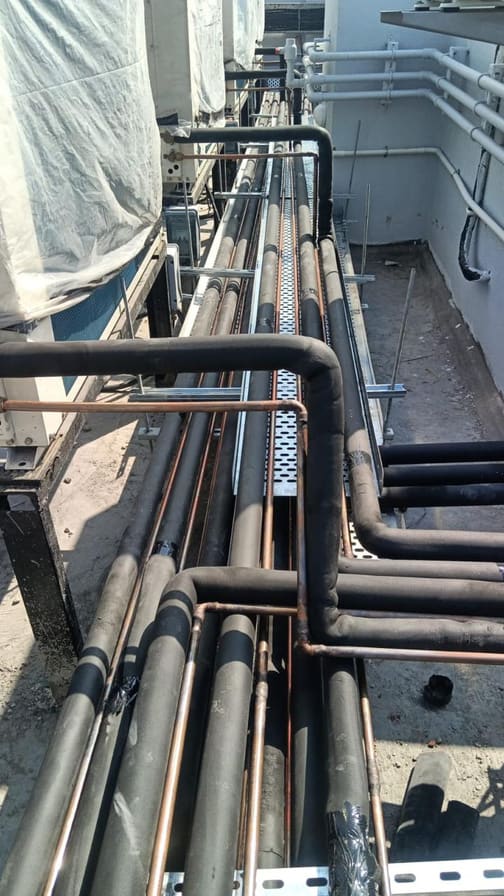
Pipe is where most long-term problems start. Undersized or thin-walled copper, poorly made flares and cheap insulation lead to leaks, sweating pipes and lost efficiency. Proper copper, correct flare tools and a torque wrench on the joints cost a little more on day one and save a lot later.
Placement matters more than people think
- The outdoor unit needs clear space for airflow, and shouldn't blow into a wall or a neighbour's window.
- Keep pipe runs as short as practical. Every extra metre costs efficiency and refrigerant.
- The drain must slope continuously downhill, with no loops or flat sections.
- The indoor unit should be level and away from direct sunlight or heat sources.
When we quote an installation, we survey the site first and list every extra upfront. If the pipe run can be shortened by moving the outdoor unit, we'll suggest it. It's cheaper for you and better for the AC.